Business relationships can be very similar to personal relationships. The more you share and trust in a relationship, the more you are likely to receive in return.
Often, I am asked by suppliers and vendors, to provide/share detailed and often sensitive information in order to help build a “strategic partnership” or “strategic alliance”. Some common questions include:
- Who do you do business with today?
- Who are your largest suppliers?
- Can you help facilitate a meeting with your CEO?
- What is your annual budget?
- How much are you spending today?
- Can you give me the names and contact information for the decision-makers in your company?
- What is the purchasing process in your company?
- How much are you paying today?
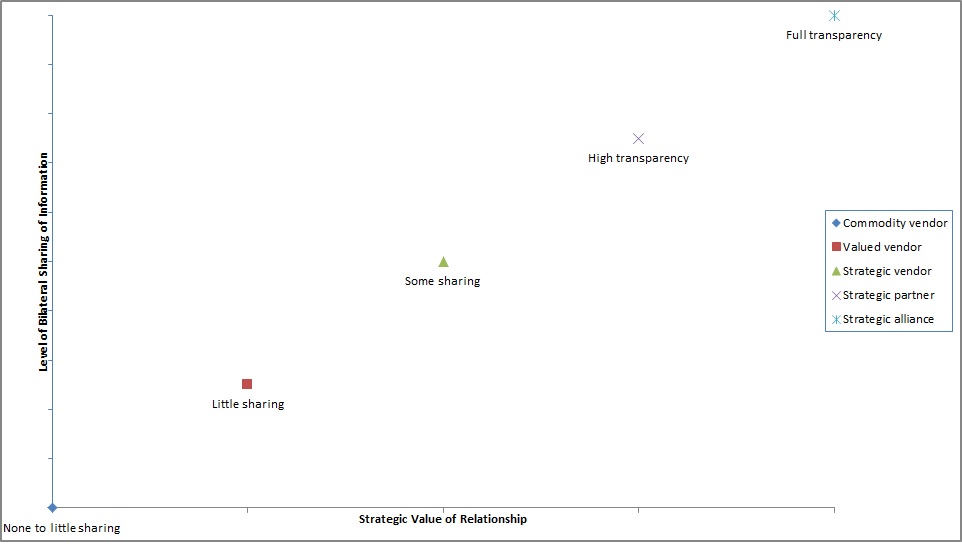
Just like long-lasting personal relationships where friendships rely on bilateral trust and sharing of information, business relationships are also built over time and mutually beneficial terms. That means that if a vendor truly wants to become a trusted strategic partner, that vendor will need to reciprocate the sharing of sensitive information and foster the business relationship over time. As in the case of personal relationships, the amount of time required to develop a trusted business relationship can significantly vary, depending on the chemistry of personalities and the business fit of the value proposition(s) vs. need.
This type of approach can be very challenging and in many cases, impossible for some vendors to adopt because of either culture or business model. For example, highly transactional vendors will tend to have a harder time differentiating themselves and will be less likely to share information. On the other end of the spectrum, there is a likelihood of developing a strategic alliance with business partners who are looking to share (technology, market information, etc.), where there is less of buyer-seller relationship.
Most vendors will be able to move towards a strategic partnership by matching transparency. For example, if a vendor wants to know how much a potential customer spends per year, the vendor may need to open up about how much the vendor sells to the industry. If a vendor wants a prospective customer to share details about available spend and timing of spend, then that vendor will need to consider sharing the profit model.
From my experience, I have been the most willing to share information with vendors who have been transparent about their business and margin models. Getting the secrecy of pricing out of the way, allows a shift in focus towards strategic discussions such as roadmaps and planning. Like personal relationships, this model won’t work for everyone. Open and strategic partnerships require the transparent and bilateral sharing of information.
 writtenbitdotcom